
Not good.
By Wolf Richter for WOLF STREET.
Food prices have been very high since the massive inflation outburst in 2021 and 2022. Then in 2023 and for much of 2024, price increases (inflation) calmed down, and prices rose more slowly off this very high level. But little by little, food inflation has been accelerating.
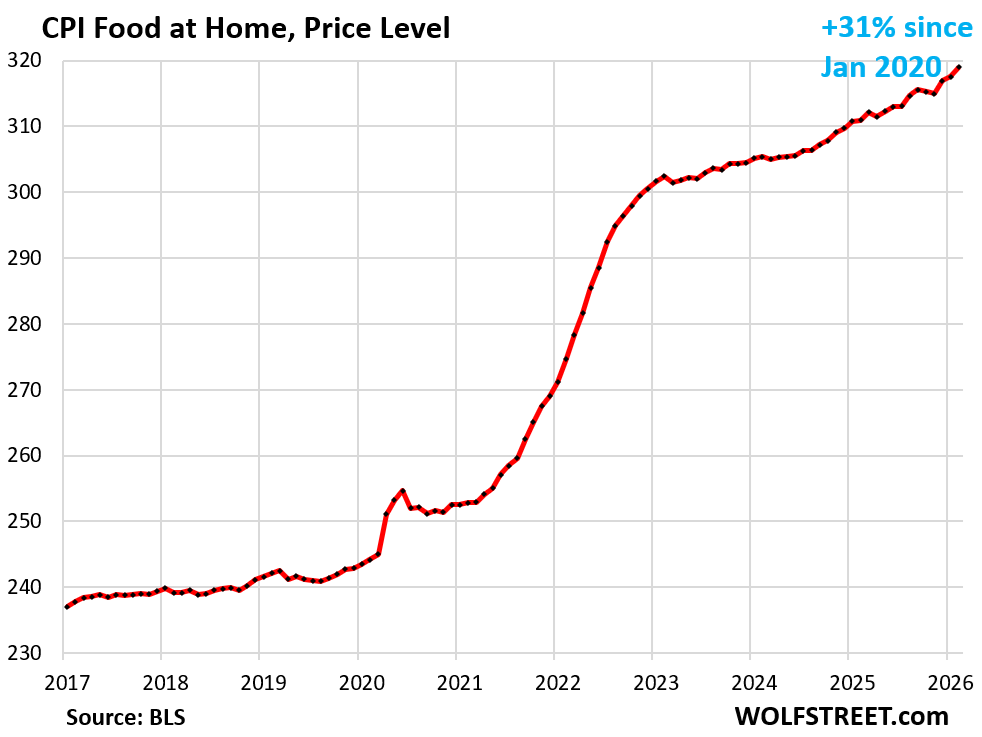
The chart shows the price level of the CPI for “Food at home” as index value. In a moment we’ll get to the rate of change of that price level expressed in percentages (inflation). What hurts is that these price increases now (inflation) come on top of these already very high prices (price level). The CPI for “food at home” covers food and beverages that people buy at stores, markets, or online and consume off premise. The price level in February was up by 31% from January 2020.
Note the dynamics: Price explosion in 2021 and 2022, followed by much slower price increases in 2023 through the first half of 2024, and then a steepening of the line, indicating that prices rose faster again off those already very high prices.
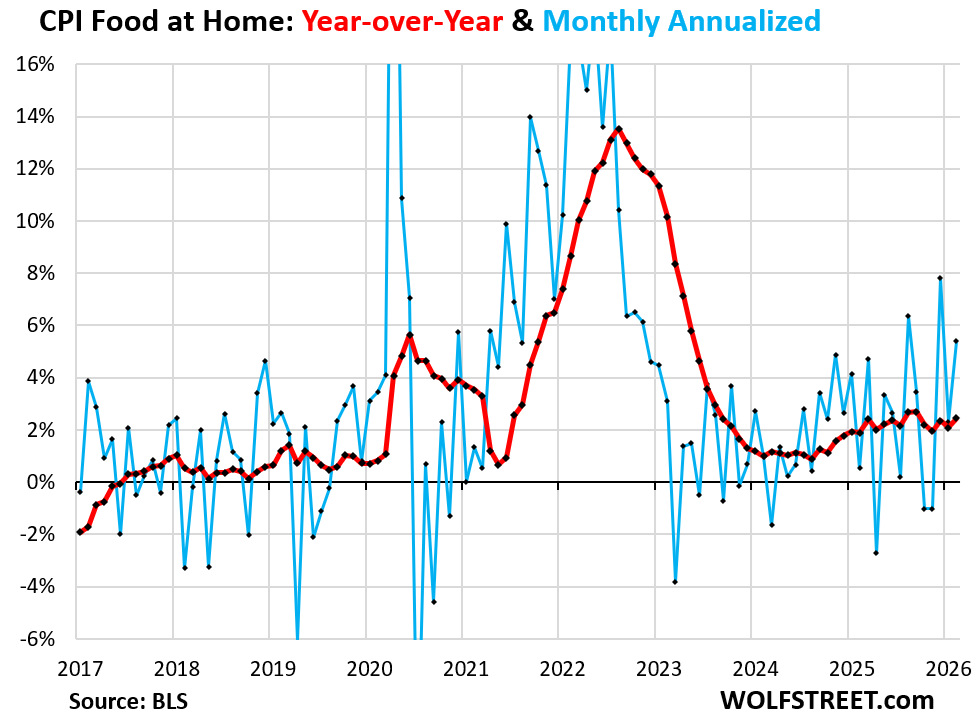
In February, the CPI for Food at home rose by 0.44% from January, seasonally adjusted (+5.4% annualized), after rising by 2.3% annualized in January and by 7.8% annualized in December, according to the Bureau of Labor Statistics today (blue line in the chart below).
Compared to a year ago, food prices have risen by 2.45%, the biggest year-over-year increase since September (red line).
Prices in some major food categories jumped in February – or continued to spike, such as beef and coffee. Prices in other categories fell – or continued to plunge, such as eggs. Other prices increased or decreased much more modestly. And we’ll get to some of the major ones.
Beef & veal prices spiked month-to-month by 1.5% (+19% annualized) in February from January, and by 14.4% year-over-year, according to BLS data.
Beef prices have been soaring since the beginning of 2021, as the US cattle herd has dropped to a multi-decade low for a laundry list of reasons, causing tight supply, and lots of profit opportunities for ranchers.
Despite the high prices, demand for beef has not yet collapsed. For prices to come down, one or both have to happen: supply has to surge or demand has to drop substantially. But neither has happened to the degree necessary to move prices back down.
Americans wail and gnash their teeth about high beef prices but keep buying it and keep paying those prices, though there are lots of delicious alternatives to beef, such as a great variety of fish, plus chicken and pork, plus vegetarian proteins.
The Bureau of Labor Statistics tracks tens of thousands of products and services by detailed items separately, which are then combined into categories and indices. So let’s look at ground beef and steak.
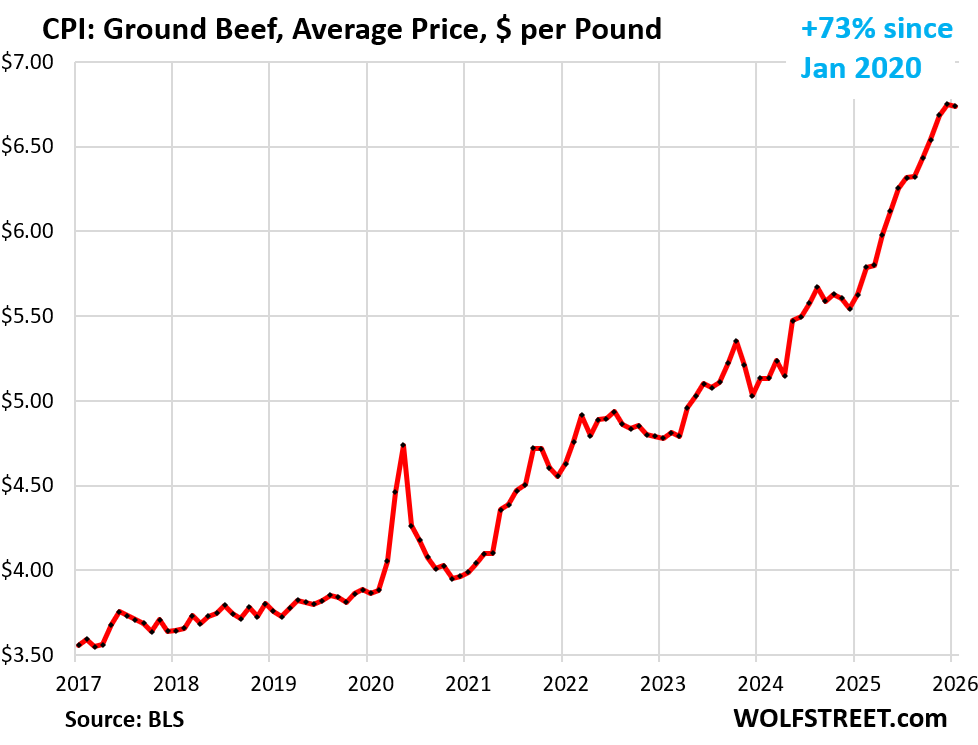
Ground beef: The average price of ground beef, 100% beef, excluding round, chuck, and sirloin, and excluding preformed patties, finally took a breather in February and barely budged, rising by just 0.2%, after spiking month after month almost uninterrupted for a whole year.
At $6.74 per pound, the average price is up by nearly 20% from a year ago and by 73% from January 2020.
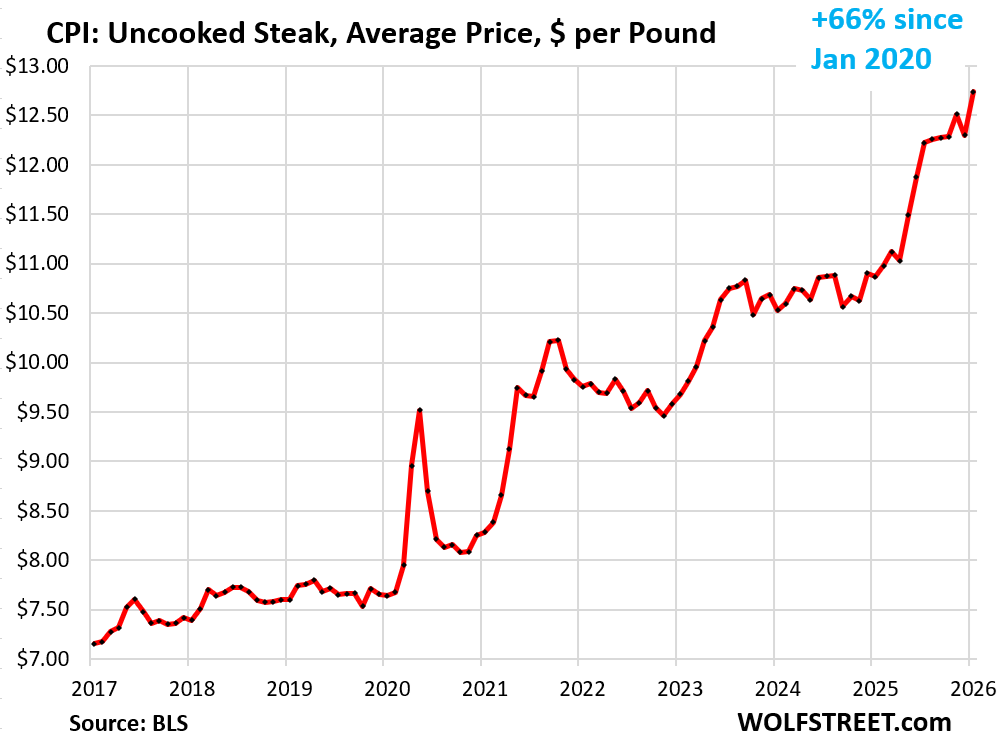
Steak… Other beef products spiked in February. For example, the average price of uncooked steak spiked by 3.6% in February from January (+52% annualized), to $12.74 per pound, after dropping in the prior month. Steak is up by 17% year-over-year and by 66% from January 2020.
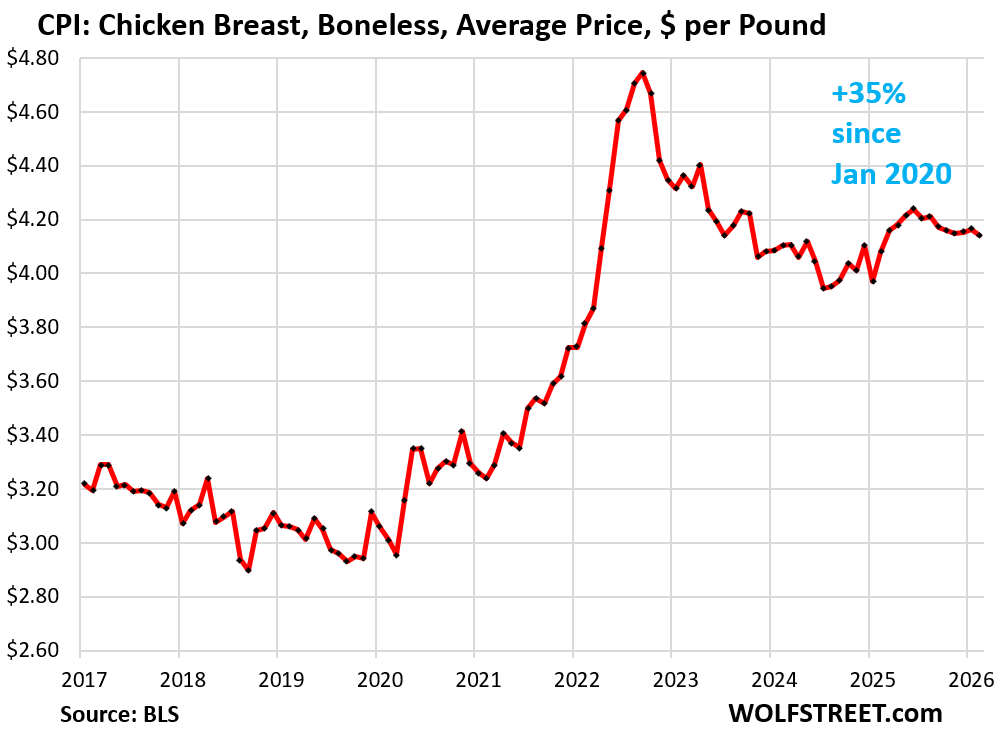
Chicken breast, boneless: The average price of boneless chicken breast fell by 0.6% in February from January, to $4.14 per pound. Year-over-year, it was up by 1.2%.
During the inflation shock from 2020 through September 2022, the price had exploded by 58%, then declined. But it is still up by 35% from January 2020.
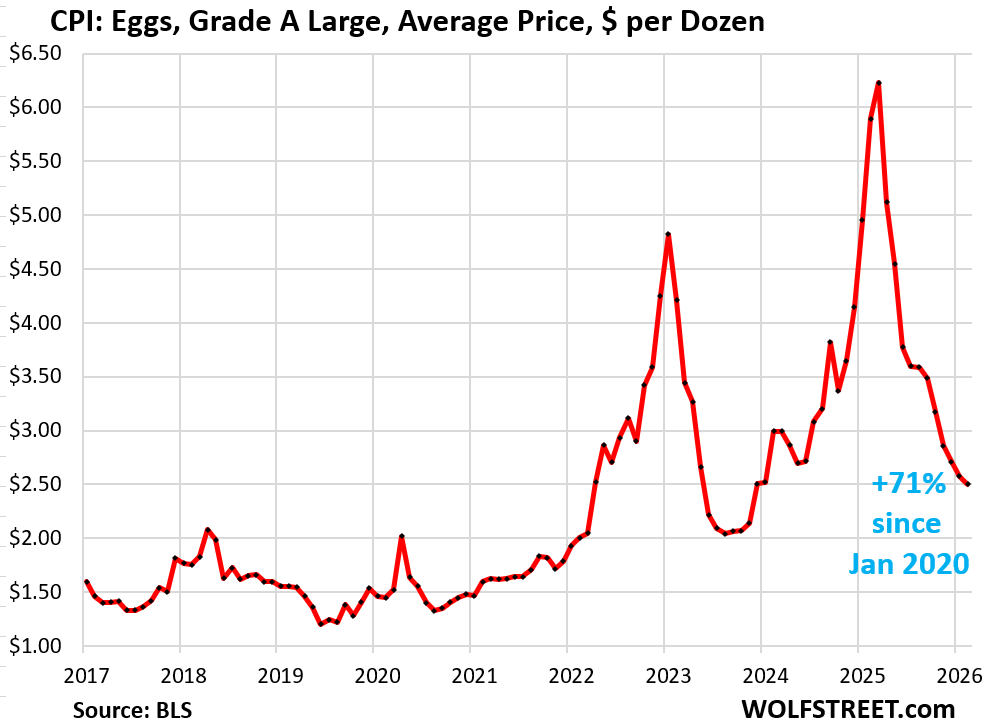
Eggs: The price spike imploded, but prices are still high. The avian flu came in two waves, the first in 2022 and the second in 2024, each triggering shortages of eggs and huge price spikes. The average price of “Grade A Large Eggs” soared by 368% from $1.33 per dozen in mid-2020 to $6.23 at the peak of the second wave in March 2025, according to CPI data by the BLS.
Then, the price spike began to implode. In February, the average price of Grade A Large Eggs fell another 3.0% from January, to $2.50 per dozen, the lowest since December 2023, having now plunged by 60% from the March peak.
But it’s still 71% higher than in mid-2020.
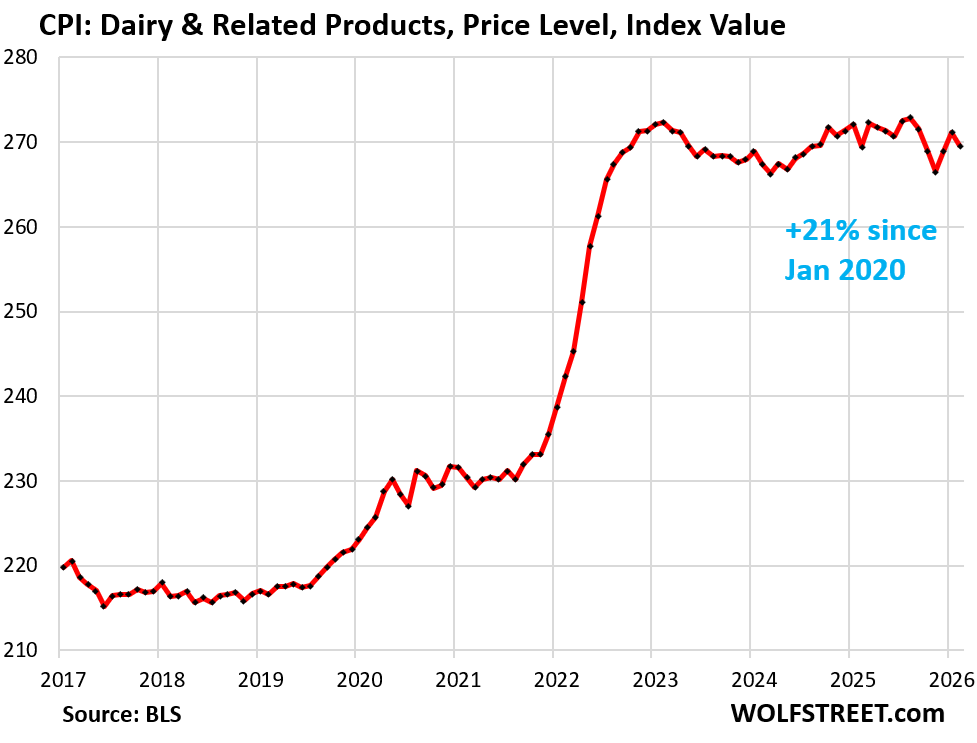
The CPI for dairy and related products fell by 0.6% in February from January and was unchanged year-over-year. Dairy prices are high (price level), but the annual rate of change (inflation) of dairy prices is now low.
Compared to January 2020, the index is 21% higher.
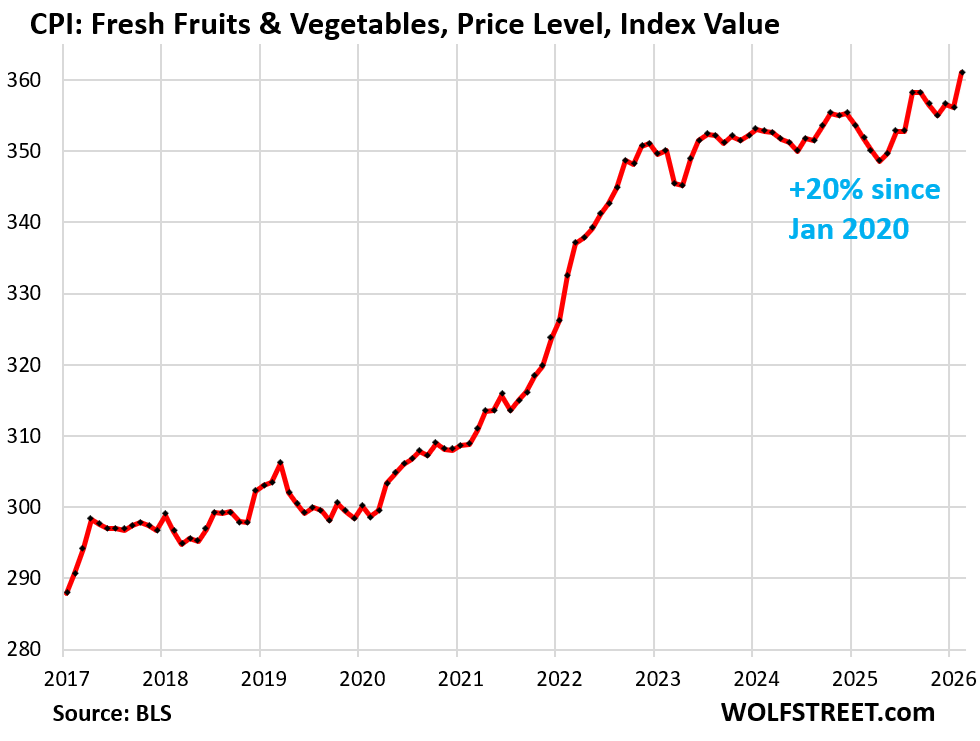
The CPI for Fresh fruit and vegetables spiked by 1.4% month-to-month (+17.8% annualized). This big move pushed the year-over-year price increase to 2.6%, after having been close to unchanged year-over-year for several months:
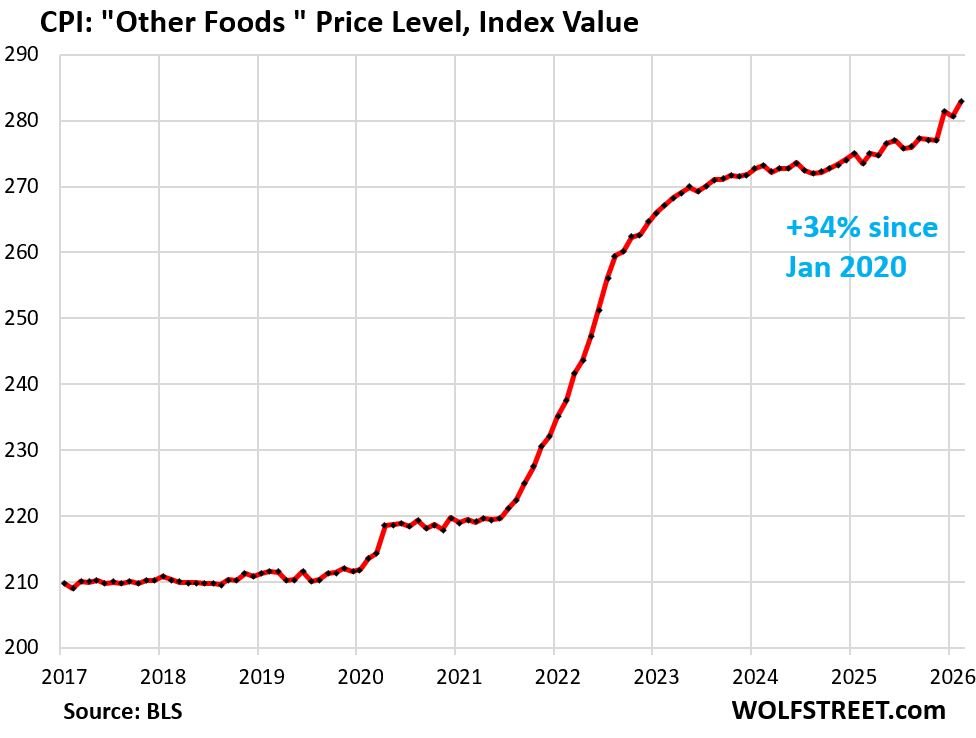
“Other foods” because we can’t post a chart of every type of food. The CPI for “Other foods” combines the sub-indices of many food items and categories that the BLS tracks separately. They include the categories for sugar, sweets, fats and oils, salad dressing, peanut butter, soups, frozen and prepared meals, snacks, spices, olives, pickles, baby food and formula, etc. So a substantial part of the middle of the grocery store.

These “Other foods” were a culprit in the acceleration of food inflation in February. The CPI for “other foods” jumped by 0.8% in February from January (+10% annualized), after a drop in January and a big spike in December.
Over those three months combined, the CPI other foods jumped by 2.1% (6.4% annualized). Year-over-year, it rose by 3.4%, the biggest year-over-year increase since November 2023.
Since January 2020, the index for other foods soared by 34%.
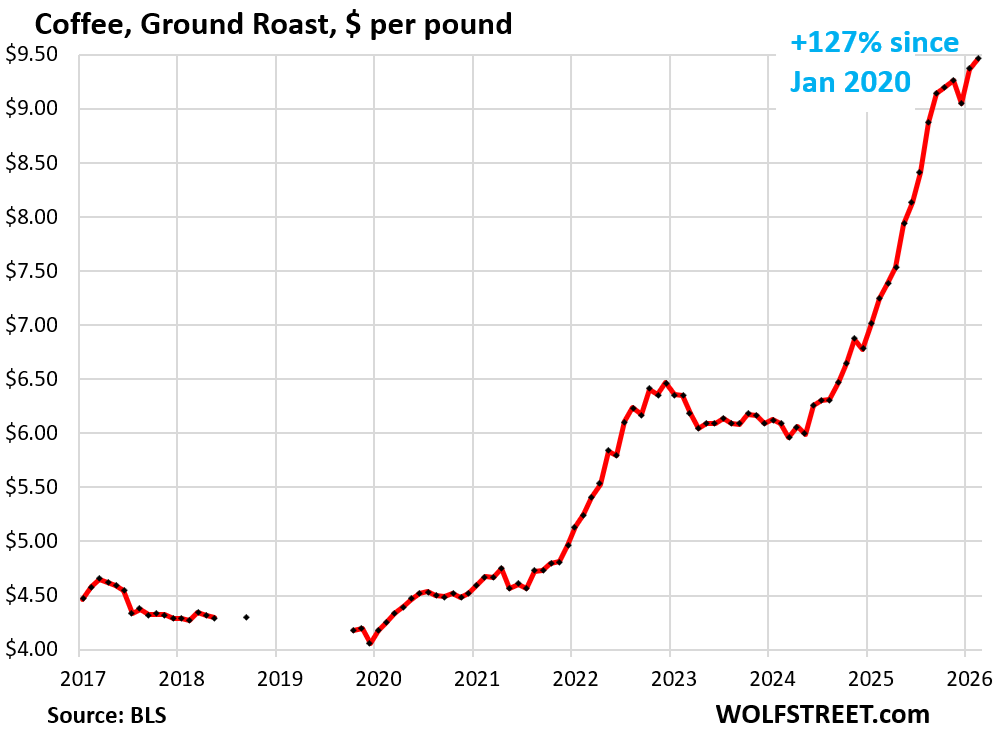
Coffee, oh dearie… The average retail price of Ground Roast 100% Coffee spiked by 1.0% in February and by 30.5% year-over-year, to $9.46 per pound, according to BLS data today.
Since January 2020, the price of this type of coffee has exploded by 127%.
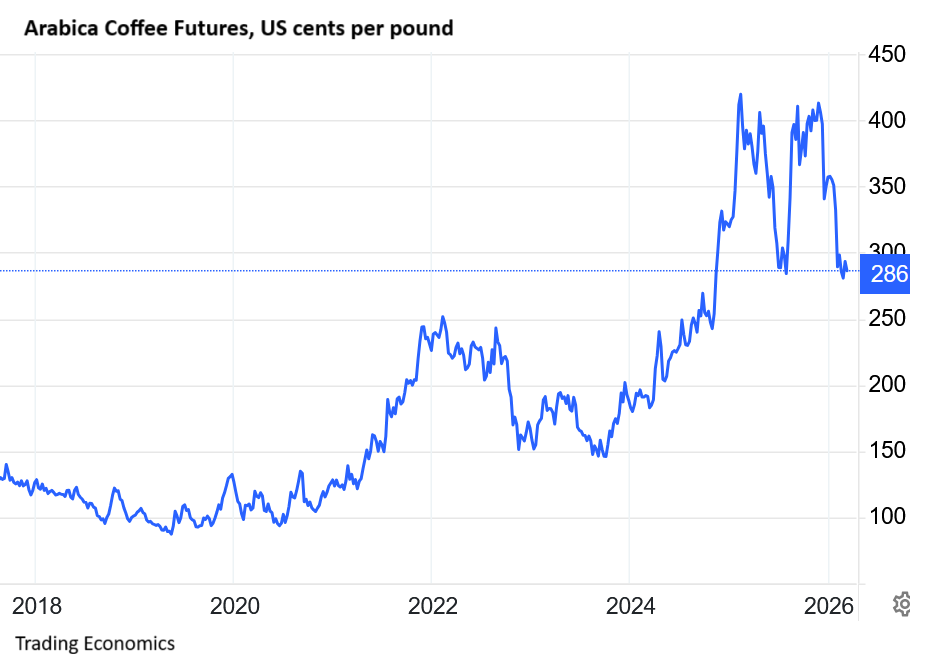
Coffee rocketed higher in two waves, roughly following with a lag the two waves in the coffee futures market: The first wave started in mid-2021, the second wave in September 2024.
But there is hope for coffee drinkers. Green coffee beans are a global commodity product, and prices can fluctuate wildly and instantly, driven by fears of droughts, bad harvests, market forces, tariffs, or whatever.
Futures prices for green beans of Arabica coffee have plunged to $2.86 per pound, from over $4.00 a pound in December.
But note, the cost of green coffee beans as a commodity is only a part of the retail price of ground roast coffee.
The current green-bean price of $2.86 per pound of Arabica compares to the average retail price of $9.46 per pound for ground roast coffee.
The difference between the two prices goes to the roaster, the retailer, the transportation companies, to wages and salaries and share buybacks, and rent, and everything in between, plus profits for everyone between the green beans and the coffee in your cup. So if the price of coffee futures drops by $1.00 per pound, as it just did, it may not reach your cup, or reach it only partially and slowly (chart below via Trading Economics):
And in case you missed it: CPI Inflation Rose on Food & Energy Prices, even before Gasoline Price Spike. YoY still Pushed Down by Bad-Joke OER
Enjoy reading WOLF STREET and want to support it? You can donate. I appreciate it immensely. Click on the mug to find out how:


I really don’t know the solution for any of this.
Just seems stuck
Besides a recession I mean
Watched 2 expose’s on the Epstein elite, and how none of these people have suffered any serious consequences, except for Gshlaine and Prince Andrew.
And then I see financial webpages like this where people are reading the tea leaves to squeak out a bit more in their lives.
The contrast is shocking.
Whataboutism.
Regardless of what happens to “the elite” it has no bearing on food inflation. The cause and the solution of food inflation do not reside in events surrounding Epstein
This site has really good info and good commentary. Let’s not turn it into something like zerohedge.
I was about to argue with Gaston that MS has a damn good point, but then I got to the zerohedge comparison, and I have to conclude they both have damn good points.
The connection between the things is that voters have been voting against their own interests for a couple of decades now, getting puppeted by social media.
Just wait until the molester and thief helps us out with operation epstien fury. We have not seen anything yet. but hey its not a women in the white house and all pets are safe from being eaten and hey were getting a ballroom so there is that.
I mean… more supply? People doing the work that’s needed. People allowed to the do work needed. Efficient allocation of resources? No wars? Imagine the price of energy a couple of weeks ago.
“No wars?”
The Ukraine and Iran Wars have definitely played a role in sustaining inflation – ditto pandemic “dislocations”.
But they have all played out against a background where a long-dysfunctional US economy – guided by leadersh*t for decades – has fewer and fewer alternatives to simple, hopeless money-printing to “fix” periodic crises.
Result – inevitable, profound, quite possibly fatal inflation.
At this point, a nasty recession really is about the only way most everything will move back towards its mean. During the GR, the median price of homes dropped about 19% over two years. Over the last 3.5 years, it’s only down about 8.5%. Over the last six years, the M2 supply has shot up as has the Fed’s balance sheet and the stock market, meaning the top 20% in income earners are literally powering the economy forward. And now we’ve got trillions of dollars chasing AI & data centers.
change taxlaw around farmers. So that a dentist doesn’t profit from lower tax rates for hording farmland. There are probably other policies that would deflate farmland prices, too.
And lower famland prices would allow new farmers to enter the market, bringing in more supply. Somehow there are record prices for all sorts of goods but on the other hand a theres a lot of corn and soy…
Bill Gates is the largest owner of farmland in the US. We can start by getting the billionaire class to back off…
Epstein Class billionaire FIFY
I’m mildly surprised that the appetite-suppressing drugs aren’t reducing demand for food and therefore driving prices down. I suppose that must be because few people are using them in spite of all the fuss in the media.
Similarly, why isn’t the expulsion of illegal immigrants reducing demand?
Or, nasty thought, maybe both of those effects are happening and still the inflation runs on.
You’re not considering where the cheap immigrant labor was working, and the impact of removing that cheap labor.
I’m wondering if the average Olympic patient has kept the same food budget and just spends it on more expensive items. Allowing the industry to get away with charging higher prices.
For immigrants, I expect they tend to purchase cheaper, more abundant foods, and don’t drive the overall market as much. To say nothing of the fact that if there are fewer immigrants, many of America’s farms become less productive, or at least their costs increase.
Not enough people can get them, supplies are restricted to people who are diabetic or are willing to pay out of pocket. Besides, they don’t help once you are off them as appetites come right back.
Some simple fixes:
Tax cuts to the wealthy
Fed bailouts for failing companies
New wars in the middle east
Import taxes on everything
Deport farm labor
All of this should help the wealth trickle down. Look up, and a bit might dribble into your mouth.
You win the internet! Kudos.
Exactly. Who could have imagined that inflation would accelerate under such enlightened policies?
It’s abundantly clear that the Fed set short term rate is too low, they should not have cut rates starting in Fall 2024, short term rates should still be close to 5%, of the Fed had stuck to its guns, inflation would be much lower. The Federal deficit spending and tariffs don’t help either.
Free markets, regulate labelling, health & safety, not production and distribution. No wasting of surplus. Local produce section in supermarkets.
It is stuck, largely because of price fixing by the big players in the industry. A recently unsealed lawsuit / FTC complaint paints a pretty clear picture (look for Pepsico Walmart price fixing lawsuit). That stuff puts a floor on food pricing, and crushes anyone who tries to go under it. And you can bet this happens for more than just Pepsi. Only way around it is to shop grocery stores that use their own brands like Aldi, and thus get around the price fixing of popular brands.
I believe a class action has now been initiated since the government abandoned the case.
I’m still finding my 2nd fav coffee on Amazon for 54 cents an ounce. Brand Name.
In the stores it’s $1-1.30 an ounce.
Still haven’t been forced to buy coffee from Costco but that may be coming.
I love the Kirkland brand dark roast personally.
Costco (at least mine) has had the Lavazza Caffé Espresso roast in 2 lb whole bean bags for only $19.99 the last couple of months. I find this roast an excellent balance for home espresso drinks, which I drink black, so appreciate the less bitterness. I’ve run a lot of roasts through my machine, and even though I was skeptical of this ones balance claims, I think they nailed it. Give Costco a shot — I have a lot of bags stocked up at that price.
Wolf – you should have titled this article “We’re screwed – oh no, not all of us – just those who eat!” 🤓 🍱
all I can say is that NOW we are in the exponential explosion of federal debt(along with states/cities/school districts)
the CONTINUAL devaluation(inflation) of fiat $dollar has made everything more ‘astronomical’
I had apartment owner ask me today if I thought we could finish for $500k of renovations
I didn’t answer given the 2-3 year timeline
learn to grow your own veggies and do community chickens
otherwise learn to eat soy products
Fortunately, alcoholic beverages are only 1.6% yoy, it’s time to substitute over from Coffee.
The Best part of waking up, is Jackie D in your cup!
You can’t drink all day if you don’t start in the morning.
There was a time shortly after I dropped out of college the first time where I woke to a shot of Jack each morning…
Good times 😆
Of course we are not ones to take anybody else’s inventory.
I was in a hardware store the other day looking for a very specific light bulb and an older gentleman employee asked if I needed help. It was probably 1 in the afternoon. I was overwhelmed by the smell of alcohol on his breath. I’m positive he was drinking on the job. Years ago I would have been annoyed because it’s just really poor form. These days I don’t blame the guy. He is probably making minimum wage and I honestly don’t know how he is even surviving on it.
You should have told him you needed help finding the whiskey aisle! 🥃 🔨
“I’m a little too hammered to find it myself!”
”Back in the day,” DC,, early ’60s, I was working with a lot of older guys in construction who would race to the nearest bar, if they could,,, and slam beers for lunch.
Most of them had fingers missing from their left hand, as they had been in the workforce when the first electric saws were introduced…
OTOH, one of my best buds, a highly paid techie, told me he never went to work ”hung over” because he made sure he was just continuing to be ”drunk” from the night before.
Beer for breakfast was almost mandatory for the ”navies” I worked with in England in the early ’70s… Probably gave them enough calories to make it to the noon meal, frequently provided by the employer who was paying us 2#s PER DAY.
Tried it once, and never again for this old carpenter!
navvies (not navies)
This is precisely what I’ve suspected. I work in maintenance and one of the places they send us is this apartment complex that was built in the 1960s. I tell the guys I work with that if you’ve been in one of those units and you haven’t said to yourself some version of “What the hell is this?”, “Who thought this was a good idea?” or “How is this even possible?”, that just means you haven’t found it yet. There’s absolutely no way that the guys who built that place were sober. Neither was the inspector, apparently.
We just had one unit where we go in, flip the kitchen light switch, and the lights aren’t working. Meanwhile the other guy is checking the appliances, he turns the oven on and the lights come on. Apparently they have to be preheated to 375° for the switch to work.
The bars around the Big Dig in Boston in the late 90’s was where the question “How many beers can a guy drink during a half hour lunch?” could be researched. The dive bar Biddy Early’s was steps away was where every customer ordered a bucket of beers.
Thank you for that depressing revelation of your matriculation.
“…excluding preformed patties”. What about those patties? Does all this have any direct effect on the cost of a hamburger? And what will happen to the Global Big Mac Index in 2026? For 2025, the index was $5.79 in the US, $5.73 in the UK, $5.43 in Canada, $4.87 in Australia and $4.60 in Mexico.
Like my Uber driver the other day.
4 stars!
All those pay rises since 2020 need paying somehow I suppose.
Then when stuff goes up more they’ll need big pay rises.
Recessions, post inflation spikes, after the subsequent tightening of rates, usually fix this don’t they?
Trump had a campaign event in Kentucky this week, and the slogan banners said “Lower Prices. Bigger Paychecks.”
And we’ll believe it all the way to the poorhouse.
I’m getting healthier and wealthier! Hoping to snort a line off a toilet seat with RFK Jr, that freakin’ genius. Nothing like having an ex heroin addict in charge of public health!!!
We aren’t really supply constrained; there’s still plenty of food available.
The problem is the middleman economy. National grocery chains have monopsony power. They drive down the prices they pay to producers and force fat margins for themselves. Farmers, ranchers, and customers lose; Walmart and Kroger win.
The answer to this is to start finding ways to cut out the middleman. Direct-to-consumer wholesaling should be more of a topic of interest.
Of course, this will all change as the war drags on. As energy prices explode and fertilizer production declines due to a shortage of natural gas on the market, then we will have actual food shortages, and it will be Katie-bar-the-door.
Sir, this isn’t a war. Only Congress is allowed to declare war. This is a retaliatory preemptive kinetic de-escalation.
Well I think that we need a a trust buster.
Oligopoly is as bad as monopoly. Both forms of market structure maximize their profits by reducing production and raising prices.
Margins for both Kroger and WalMart have been either consistent or falling since 2014:
https://www.macrotrends.net/stocks/charts/WMT/walmart/profit-margins
Looks like hot dog water for dinner tonight
Well, Washington State is joining the pantheon of state income tax states. Of course, this is after they raised the B&O gross receipts tax, implemented a capital gains tax, highest death tax in USA, very high minimum wage, huge influx of foreign nationals, rampant homeless, and others goodies. Then… inflation.
Bezos, Schlutz, and Starbucks are gone. There is another local, small “b” billionaire who quietly left. Funny, quiet quitting crappy, local tyrannical
governments.
There are some hurdles like the state constitution and citizen led initiatives, but I am figuring this millionaire’s tax will be similar to California’s tax rates within 5 years, if not sooner.
The ironic thing is that I have plans for living as a traveling ex-pat, but I
didn’t plan much for my local domicile. Lots to do.
Good luck, folks.
WA is shooting itself in the foot. If it’s going to be a high income tax state, the high income people will move, the economy of the state is totally built on “no income tax”, and the way they passed the bill, with a fake emergency provision that blocks a referendum, if the people of WA have any brains they will vote everyone in the legislature who voted for this into early retirement.
I wouldn’t say Washington now has an income tax in any normal sense.
If you make $1M or less per year, you pay nothing, so it exempts around 98% of the population.
Prior to this tax, Washington state had one of the top REGRESSIVE tax systems in the country.
In my opinion, the middle and lower classes in Washington needed the relief. They have some of the highest housing costs in the nation. A basic 3/2 home in a good neighborhood now costs $1.3M or more. And gas is $4.50/gallon.
I’d like to feel sorry for the MSFT, GOOG, AMZN, and META executives, but they’ve done very, very well the past ten years.
“If you make $1M or less per year, you pay nothing, so it exempts around 98% of the population.”
This is the same argument used for the federal income tax in 1916. I’m sure the state needs the money for all the “vital programs” they want to fund, but before long it won’t be enough and “the middle and lower classes” who needed the relief, will be the one’s actually paying the most.
I did the traveling ex-pat thing for ten years, going from Mexico, south through all the Central American countries (except Belize), and into Colombia. It is much easier than you would imagine, especially if you have a pretty good grasp of Spanish. Most of these countries will give you a ninety day visa, with an extension of another ninety if you wish to stay longer. Good, clean, and safe hotels in the twenty to thirty dollar range are abundant, many with free breakfast and internet. If you’re willing to visit small villages, the accomodations are even less costly, though usually without internet. I count those years as some of the best of my life.
“The ironic thing is that I have plans for living as a traveling ex-pat”
Good…enjoy your travels…
The broader pattern is that places like California and New York are exporting their low-wage earners to places like Texas and Florida. They are, essentially, becoming state-sized gentrified neighborhoods with a steep economic barrier to entry for anyone who wants to come live there.
Eventually, this will lead to a “Hunger Games” nation where the highest cost, highest tax places will the the “Capital” and the rest of the population will labor for dirt wages in the cheap places.
At least that’s the hope of the NIMBYs preventing high rise construction in California.
Billionaires are competing to see who can contribute the least back to their country. The winner of that contest becomes the king. States are competing to make the king. Democracy is toast.
The thought that comes to me has to do with empty stomachs having nothing to lose.
Empty stomach? Americans? You know they are by far the most obese population in the whole wide universe?
Might want to recheck your numbers. Might be winning in overall raw numbers, but we aren’t even top ten percent wise.
Hm, literally second right after Egypt. Unless you want to count island nations or mini states like Qatar.
It is so much more expensive to eat healthy than it is to eat cheap.
And the cheap foods tend to be the ultra processed, high sugar, high fat, etc. foods.
Let them eat cake, I guess…
There are many cheap healthy foods available at grocery stores. 40oz of oats for $4. 5lbs of potatoes for $3.50. Apples, roma tomatoes, carrots, cabbage, bananas, chicken and tuna, peanuts are all cheap.
I agree that America is obese. I mean just go to walmart on any Saturday and observe an obese population consuming
+1
Does the “online” part of this include food purchased through food delivery apps?
For example, if I pay for someone to shop for groceries at Walmart for me, is the total price of delivery and tip factored into these charts?
Or is this just in-store/online retailer prices?
These are prices paid for food NOT consumed on premise — food you didn’t eat inside where it was sold. This is about prices of food you purchased ANYWHERE, including online, to eat off-premise, such as “at home” which is why this category of prices is called “food at home” (see title of first chart).
The other category of food prices is for “food away from home,” which is when people eat out, such as in restaurants or to-go, but those prices are not discussed here.
The explanation in my article seems pretty clear to me:
“The CPI for “food at home” covers food and beverages that people buy at stores, markets, or online and consume off premise.”
I am not cheap but frugal,look for sales/get eggs from a friends chickens in return for watching them when he travels/use meat as a add on treat to other things like rice and veggies/do a tiny bit of gardening(that will change if I ever get large acreage but that is a whole nother inflation story!).
I missed out this year on a 1/4 cow order,will be on it next year assuming we are still here.
Yes,folks with empty stomachs have nothing to lose,tis why you prep goods/skills/clan as best as you can.
If….if you have any property, (even a city lot/balcony) gardening is a very wonderful hobby that can quickly morph into a passion. Great outside exercise, satisfying, and no chemicals in your food. We have a huge glass greenhouse built from free scrounged safety glass and yellow cedar timber framing, large gardens, chickens, etc. Used to have Katahdin sheep for lamb but the threat of cougars just became too much hassle.
Anyway, since Covid the price of commercial store/online bought seeds and gardening products have become insanely expensive . We save most of our own seeds, but if you want a hybrid for a specific reason you have to buy seeds from a producer. For most people home gardening IS NOT cost effective. I have crunched the numbers for years/decades and it just isn’t. I sell eggs to neighbours which more than pays for the feed and our infrastructure is in for 20+ years and all built by me, but if you have to pay for this stuff you may as well go to the store and work on recipes for cost savings.
What are we doing for this year’s worries? Expanded potato crop (Russian fingerlings), + will have a years worth of frozen tomatoes (for sauces and soups), + we buy no green or wax beans as they also freeze well, and will also have 1/2 freezer full of home caught salmon fillets. Squash. Starting in about one month we will have fresh lettuce to eat….and celery is already started in the potting shed. My wife does the seed saving when we are watching a streamed movie or show…….doesn’t even have to think about it.
For many months we have our own long english cukes, fresh tomatoes, and
different lettuces.
Our deserts all winter are frozen berries with milk (better than ice cream), zuchinni bread, or apple pie for guest dinners.
Chickens eat all kitchen scraps. All. 4 hybrid layers produce 4 eggs per day. More than 4 is a pain in the butt. Meat birds not worth it. Cheaper from the store on sales.
An old neighbour moved to a retirement home a few years ago. He then grew some potatoes in pots on his balcony + tomatoes. I have another neighbour who turns 99 next month. I will be planting 12 tomato plants in his greenhouse for him this year, just like last year. He can still go out and fuss and pick, water. It keeps him going, something to look forward to.
Savings hint. If you drive by an apartment or house getting a reno they will usually give you the old windows. Sometimes they charge $10 for a sliding glass door. If the door is double pane you can get 12′ to 16′ (lineal) of safety glass almost 7′ high for that $10!!!! A good commercial greenhouse can cost well over $20K, and a glass one like you see on Brit tv $50K. I have about $500 invested in my glass greenhouse….just for the cost of the twin-wall roofing material. Sweat was free.
Very Impressive
Paul,seems you have a good plot of land/system going,I ever get me home with minimum 20 acres will be doing a lot of the same.
i have some old slider doors(seals intact0,going to make some thermal siphon collecters for home hot water and heat supplement,perhaps get enuff might cover it all heat wise.
Coming from a farmstead to a typical city lot a few years ago was a challenge far damn shore J, but the point is to do the best you can right where you are right now:
Any window can be made to produce some food,,, albeit maybe nothing more than sprouts, etc., but they will taste better or as good as what you can buy, and be a ton less costly.
Our small yard now contains producing: bananas, papayas, avocadoes, mangoes, figs, and one lychee tree.
Of course we share with the birds and squirrels, but we still get our share at about one tenth the cost of purchased equals, and we KNOW no poison has been used on them.
Southern Exposure Seed Exchange is a relatively low cost supplier of seeds. They are out of Mineral, Va. They are way cheaper than the major seed companies that have been bought out. They carry a lot of organic and heirloom varieties.
Bootstrap Farmer is out of TX. They carry a lot of materials for building your own greenhouse and related items.
Chelsea Green is a British publisher with a warehouse in VT for US shipping. They have a lot of books on homesteading and running a self sufficient farm.
I did 50 Cornish cross last year. In 8 weeks I had 48 whole birds at over 5# each dressed. Lost 2. Fat little bastards. Cost per bird was only $6 and that included the chicks themselves. Best chicken I ever had. Our neighbor keeps his horses on our land. We buy a whole cow from him each summer at a discount and it fills the freezer and lasts a year. Last summer we went fishing in FL and brought home 6 months of amber jack. Another friend did pigs, but he moved last year…
Our summer garden produces more veggies than we can give away. We feed most to our egg birds. Once you do this at home, the store bought stuff tastes terrible. Home made pizza sauce and salsa is my fave. When we run out in early spring, it’s a bummer.
It is not that Americans wail and gnash their teeth but keep buying beef. It is that most Americans (the lower 4 quintiles) reduce their purchases of beef but the fat and happy holders of stocks at ridiculous valuations keep buying because they do not even notice the prices.
There is a solution. The only solution is a market crash back down to where the Buffett indicator is like 130% rather than 230%
It’s interesting that some commenters here seem to think a market crash and/or recession is the only way to reduce the growing inequality in this k-shaped economy, where the middle class is shrinking but the upper and lower classes are growing.
There’s also policy that could reduce such inequality, wouldn’t require a market crash, and could foster the middle class again.
Good idea. Enlighten me. What type of policy? And more importantly, WHO in our government is capable of or has any interest in such policy?
Good one Wolf I like this article however you know I keep seeing this beef cattle herds are down which I agree with, here in Texas, I drive around Central Texas and cows are still everywhere so the reduced herds may be in other states, even though I know the drought we’ve had here in Texas has also reduced herd sizes. It’s just hard to see driving around. Lucky enough I can still get a whole cow processed and it’s like 5.75-6.50 /lb. But you better have a big freezer ! Good luck to all out there.
Yep,even a 1/4 cow takes up a lot of space(but worth it).
In northern N.H. during hunting season home dept has signs on freezers different sizes i.e. 1 deer/2 deer/3 deer/4 deer,will say the supposed 4 deer one seems you only got small deer(which is still OK).
I have built relationships with local farmers,hope they remember me when times get more challenging.
MW: Dow, S&P 500 and Nasdaq decline at opening bell after crude oil surges as high as $101
CL00 +8.41% UK:BRN00 +7.97%
A nickel ain’t worth a dime anymore.
So much doom and gloom. These numbers look promising compared to nations on your borders. Production is key, do anything you can to produce because the moose people of the north reduced production of a lot of goods and services, and now suffer for it.
Our gov’t made the mistake of thinking it was as strong as the US when dealing internationally, China proved them wrong.
New very large copper gold mine starting on the North Island this year….fast tracked by new Govt with 1st nations participation. Sask uranium now heading for India, ring of fire mines starting to open this year. Look for Churchill Port expansion, new pipelines for oil export, and expanding LNG on west coast. My old neighbour earns $250K as a boiler maker, age 42. He has been working on LNG construction for over 5 years now. My son made that and more in Ft Mac, 2 weeks on/2 off, lives on the coast. There is work and lots of it if you hustle and are willing to move where the jobs are.
This is literally the price you pay for allowing consolidation of the country’s largest food producers and grocery chains. While little can be done for items like coffee which cannot be produced domestically the real culprit here is price gauging. How else is Con Agra going to pay that 8% dividend? The price of Heinz ketchup is an unreasonable premium. I shopped at the same Kroger for nearly 20 years but I had to move on because their pricing is ridiculous. Massive swings in everyday products for no apparent reason. Trader Joe’s is the market disrupter!
Can one produce coffee in a hot house,not sure economically worth it but guess might be a interesting experiment.
If one were interested the information is out there. However the use of ones time could be much better spent me thinks.
Yes, this.
As I mentioned in my comment above, it’s not a food shortage problem (not yet anyway), it’s a middleman problem. National grocers and Big-Ag have monopsony pricing power and the squeeze out everyone else, both the primary producers and the retail end-customers.
It isn’t even really correct to call this “inflation.” We could have all the inflation in the world and as long as it was evenly distributed, all you would get is a wage-price spiral. Prices would go up, but it wouldn’t matter because nobody would lose purchasing power.
But what we have is stagnant wages and higher prices, with the difference going directly to the C-Suite. It’s financialization, not inflation, that is the real monster.
“But what we have is stagnant wages and higher prices,”
Part one is wrong (I get really tired of these throwaway lines; read some of the articles here), part two is correct.
Wages have been rising faster than inflation for over two years, and they’re still rising faster than inflation, but the margin between the two is getting thinner as inflation accelerates.
Here is one measure, nonfarm jobs, “average hourly earnings” rose by 3.7% yoy (but there are many others, including disposable income):
https://wolfstreet.com/2026/02/11/private-sector-ramps-up-hiring-job-losses-mount-at-federal-state-governments/
LOL did this “monopsony” spring into existence in 2021?
The inflation is and was Fed created, aided and abetted by massive stimulus and deficit spending from both parties. Take away the punch bowl with adequate short term rates and QT for long term rates, and inflation will vanish like frost on a May morning.
EVERYTHING is a “middle-man” problem. It’s the American way! I actually stopped paying my home insurance once the property was paid off and simple rolled the money I would normally spend in T-bills. Yeah, I have had some storm damage since then but had more than enough money to fix all that plus redo a kitchen and bathroom.
Unfortunately now the most significant middle-man is now CONgress…
Hedge accordingly.
Kroger is one of the most egregious price gougers in the business and it has also turned most of its stores into ghetto dump sites.
Krogers have been ghetto dumps for like 30 years lol, at least where I grew up in GA. I always hated going there
Kroger is in the grocery polishing game.
They buy a grocer who charges far more, has a higher salary clientele. They then pull out a magic polishing rag and rub it on the groceries. This rag makes the groceries:
1. Shine more
2. Taste Better (even though they look the same, with same ingredients)
3. Much more expensive.
These higher salary people love shiny groceries and also love not caring about prices. Cuz you know what? They’ve earned a little “richness” as it were.
/s
Food prices are just a tiny little bit of overall spending by consumers in the US and it is always very easy to substitute much lower priced food for any category of food.
According to the internet, the bottom quintile of the income distribution spends about 32% of their income on food, as of a couple of years ago. Even if it was a tiny percentage, for someone living paycheck to paycheck, any increase in a small-percentage necessity like food would hurt just as much as an increase in a high-percentage necessity like housing. That number is also going in the wrong direction, and shutting down a large portion of the global nitrogen fertilizer supply at the start of the northern hemisphere growing season is definitely not going to help us with this thing the peasants are calling “affordability”.
For 2024, the BLS indicates avg annual household expenses of $10,169 on food (12.9 per cent of total expenses). They break this down into $6,224 (61 per cent) for food at home and $3,945 (39 per cent) for food away from home.
Also for 2024, the USDA Food Expenditures Series indicates per capita food expenditures of $7,589 with $4,470 (58.9 per cent) for food away from home and $3,119 (41.1 per cent) for food at home. Their trend has moved from roughly 50/50 through 2013.
Why BLS indicates food at home is 61 per cent while USDA indicates 41 per cent is beyond me. To your point though, food at home is roughly 5 to 7 per cent of household expenses.
Here is a chart from the USDA about $ spent on food (left axis, blue columns), and % of income spent on food (right axis, yellow columns), by income quintile:
Thanks. Informative chart, showing there is more nuance than the averaging methods applied to the gross population.
I don’t know how you know where all these things are…I love a good infographic and will now get lost in Charts of Note.
Any thought though on why BLS and USDA show opposite trends in the proportion of food away or at home?
I haven’t checked out your numbers, but per your text, one difference is that the BLS is using “per household,” and the USDA is using “per capita.” And then it kind of makes sense. A household is about 2.1 people in the US. So multiply USDA’s $3,119 for food at home per capita by 2.1 = 6,550 per household. That’s pretty close to the BLS’s $6,224 for food at home per household (that 2.1 is just rounded off top of my head; if I had the actual figure, the two might match perfectly).
Mortgage rates swing back above 6%, raising tricky questions for buyers and sellers
A recent dip below the 6% level had buyers and sellers feeling hopeful about a thaw, but the Iran conflict has put uncertainty back on the table
The mortgage rates seem about right putting an affordability limit that people can afford to pay. The problem may not be the interest rate but the asking price which is not affordable for most of the American young couples eager too procreate
1:04 PM 3/12/2026
Dow 46,677.85 -739.42 -1.56%
S&P 500 6,672.62 -103.18 -1.52%
Nasdaq 22,311.98 -404.16 -1.78%
VIX 26.85 +2.62 10.81%
Gold 5,094.10 -85.00 -1.64%
Oil 96.39 +9.14 10.48%
“The price level in February was up by 31% from January 2020.”
But it feels like 131% if you have kids…
If you didn’t have kids in 2020, and now you have kids, yes. But I don’t think that’s within the parameters of the definition of inflation 🤣
It’s because kids eat 131% more than adults. well the federal trade commission being eviscerated sure doesn’t help. Greedflation run amok. If the supermarkets start buying back their shares like the airlines do, we will be in real trouble. “greed begets greed”
I keep guessing that (especially in Europe) huge inflation since 2020 and mass immigration since 2020 have been both policies to make wages more affordable in real terms, similarly to huge inflation and mass offshoring in the 1970s-1980s.